By Tuğçe Karataş
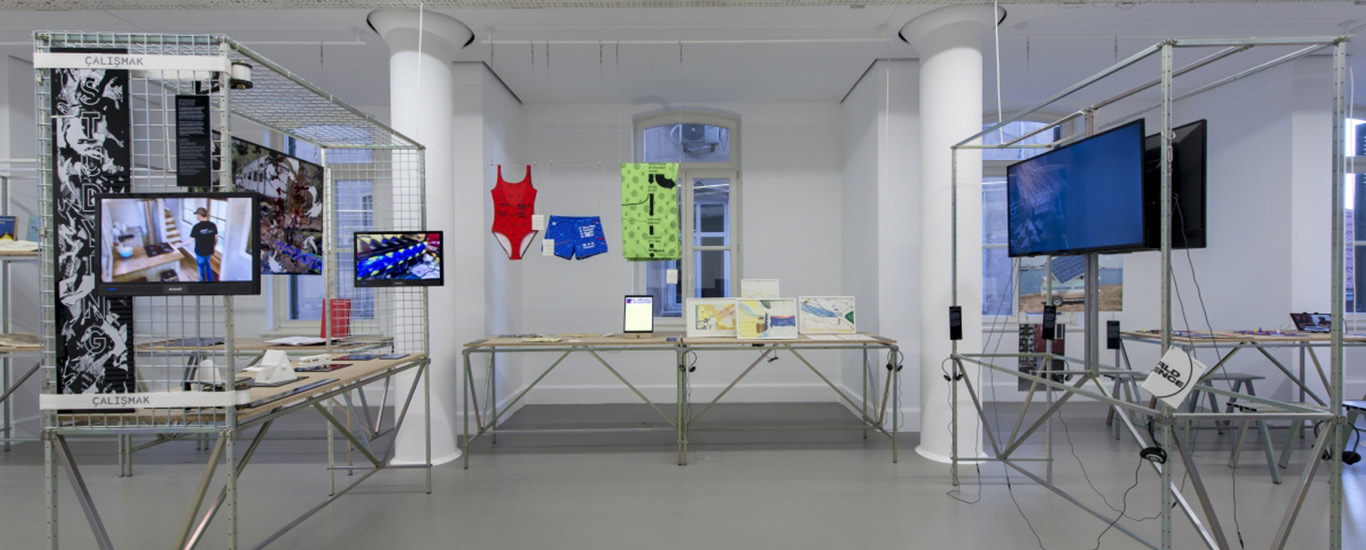
Hannes Bernard and Guido Giglio have been collaborating since 2012 on interdisciplinary projects that merge research and design. Giglio is an architect from Brazil and Bernard is a graphic designer from South Africa; both graduated from the Sandberg Institute’s Design Master programme. Based between Amsterdam, Cape Town and São Paulo, they collaborate under the moniker of SulSolSal, which means “South, Sun, and Salt” in Portuguese. Their projects combine cultural, historical and economic research to create communal spaces, publications, video installations and food performance as a means of investigating the complex relationships between design, economy & society. SulSolSal will participate in the 4th Istanbul Design Biennial – A School of Schools with an installation titled Staying Alive, which examines the escalating frequency and scale of disasters, crises and catastrophes in recent years: from ecology and socio-economics to politics, ethics and technology. As a response to an uncertain future, preparation for a broad array of possible doomsday scenarios has sparked new interests, hobbies and communities, as well as alternative channels for the production and distribution of emergent knowledge. As Bernard and Giglio visit Istanbul for the installation set-up, we discuss their work and approach.
Tuğçe Karataş: With regards to your design education, how did you two meet and how did SulSolSal emerge?
Guido Giglio: I am from São Paulo, Brazil. I studied architecture at the University of São Paulo. The program was quite influenced by the Bauhaus and modernist tradition.
Hannes Bernard: I am originally from Cape Town, South Africa, where I studied communication design and culture studies. We met in 2012 while both attending the Sandberg Institute in Amsterdam and began working together shortly after meeting. What brought us together was a mutual recognition of our experiences in the “South”. We were both interested in the triangulation of culture, history and politics between Europe, Africa, and Latin America, and the potential for a new discourse regarding this relationship.
TK: This year the 4th Istanbul Design Biennial has a research and process-orientated approach. How has your project emerged from this perspective?
HB: Our practice is grounded in research – we collect imagery, data and cultural phenomena in order to map novel relationships without necessarily having a pre-designated project in mind. From this fluid collection of materials we consider possible overlaps, juxtapositions, conflicts or speculative narratives. In this sense, our work is process-orientated, making use of a fluctuating exchange of materials and positions. Within certain formats – for example our generative video installations – the underlying process of exchange is made apparent in the final form. This approach is perhaps a result of us grappling with shifting perspectives and slippery ideological constructs across historic, geographic or cultural borders, as the exact content of a work changes depending on where and when it is seen.
GG: We feel the question of what ‘Southern’ design could (or should) entail has relevance beyond any specific geographic region. How this might be understood, however, differs a lot from one part of the world to another. We are not only interested in Southern conditions – such as permanent states of crisis – merely as they manifest in Brazil or South Africa, but also in how those realities are increasingly reflected within a Northern context.
HB: Through ongoing research and a series of projects over the past two years, we have been studying and experimenting with new acts of survivalism as they relate to the broader topology of disaster today. This project touches upon a number of domains, including drastic changes in fundamental social infrastructures such as housing, healthcare and labour conditions. Within the exhibition we explore the imagery and strategies of preparation or readiness in light of these changes and the impact of underlying existential threats such as climate change, economic instability and the fracturing of traditional political formations.
TK: Can you briefly explain the curatorial approach for the installation?
HB: We try to create a number of perspectives on this subject, not only through our own work, but through the inclusion of projects by other designer and artists. For us, it is important to create connections between various (or even opposing) design ideologies and methodologies. The exhibition proposes a platform for design that intersects economic, social, ecological and technological interests. In terms of engagement, we bring these different responses or readings of disaster in dialogue with one another. For us, this is one way of opening up a discussion amongst both practitioners and the wider public regarding the potential and urgency of divergence within design discourse.
TK: How does your project as a part of 4th Istanbul Design Biennial relate to this year’s theme, A School of Schools? Can you briefly explain your thoughts on design education in its current state?
GG: Schooling and education are essential to the idea of preparedness. Students are preparing for a certain future, attaining specific knowledge with the belief that it will be useful in the future.
HB: The rise of neoliberal governance has disrupted the position of schools as fundamental structures and resources within communities, while increasing privatization limits the role of education – not just how one studies, but what is studied – to knowledge and skills that are primarily valued by the market. Historically, social crisis has largely been a domain of government. As trust in state institutions including schools has eroded, individuals are increasingly taking on the responsibility to learn about, prepare for and react to an uncertain future themselves.
GG: Until fairly recently, education was mostly accessed via institutions. This notion has been totally displaced by the abundance of knowledge available online. The explosion of auto-didactic education is one clear consequence of this, and we now see new and expanding communities of ‘learners’ as a result. This presents an interesting paradigm for design education - one in which methodologies open up to embrace these new intersections.
HB: Within design education we are often confronted with grand notions of ‘what design can do’, though a more relevant question might be ‘what design should do?’. In researching and curating works around the topic of disaster, we saw two different framings of this subject. On the one hand, designing for the future can be pragmatic: accept an inevitable future of resource scarcity, and leverage education as a tool for more efficient and fair management of that reality through smart design and innovative technological solutions. On the other hand, the role of education can be highly ideological: reject this notion of scarcity as inevitable, and study it critically as something that is itself a result of hierarchies designed by entrenched systems of power. We don’t want to answer ‘what design should do’ in any definitive way. Rather, we are more interested in presenting the possibilities in order to provoke a dialogue through a broad range of responses.